Boardscooter Speed, Flex, and Flow

Why does Boardy feel different, and why does this matter?
On a human powered scooter, speed is not simply the result of force. It is the result of cooperation.
Boardy is built around this idea.
Energy Loss and Scooter Speed
It is obvious that some energy loss exists in any flexible system. When riders see our slow-motion footage of a Boardy’s deck flexing under load, it naturally raises questions about how much energy is dissipated. Discussions often try to put a number on this, and various estimates have appeared over time. However, in our view, the idea that flexibility alone causes a 20 percent loss in scooter speed is an overestimate. This claim is not supported by measurement or comparative testing.
In reality, overall efficiency depends on the entire system. Boardy performs very well in other loss-critical areas. Large pneumatic wheels inflated to 4 bar, combined with sealed industrial bearings, result in low rolling resistance and reduced friction. These factors often compensate fully for the amount of energy dissipated through flex.
Flex is not a loss: vibration damping as the reward
That remaining loss is not wasted. A small portion of energy is converted into heat as part of vibration damping. This is the price of flex, and the reward is reduced shock, lower fatigue, and smoother continuity instead of harsh rebound. What the rider feels is not resistance, but flow.
Rhythm instead of brute force: mechanical efficiency in motion
On a rigid scooter, speed depends almost entirely on the strength and frequency of kicks (kick force and kick rate). These factors also matter on Boardy, but technique and proper rhythm matter just as much.
When the rider learns to move together with the scooter, the system becomes mechanically efficient. When the flex of the frame works in the same rhythm as the kicks. This is why experienced riders often feel that Boardy accelerates more smoothly and maintains speed with less effort.
This is also why two different riders can have completely different experiences. Boardy rewards adaptation and responds to its rider.
Yes, Boardy can be fast
Boardy is often described as smooth, quiet, and comfortable. All of this is true. But that does not mean it is slow.
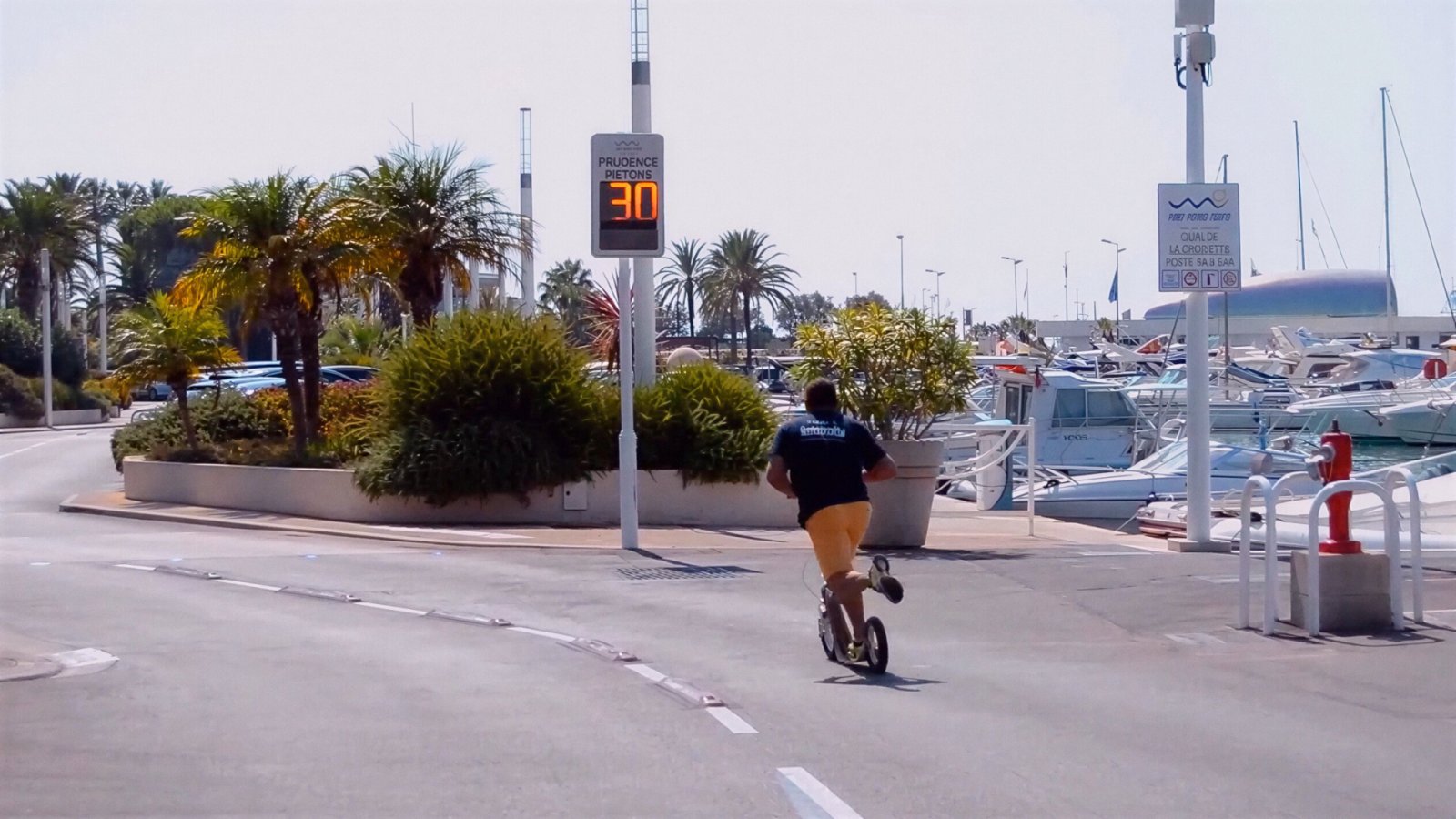
With proper technique and terrain, Boardy reaches speeds that surprise those who assume comfort must come at the expense of performance. There are real world riding videos showing this, including a pass-by of a roadside speed display. Not laboratory tests, not marketing claims. Just rider and machine in sync.
On Boardy, speed is not created by fighting physics. It is created by using physics.
A living system, not an inert object
This is why Boardy is sometimes described as feeling alive. Not because it moves on its own, but because it responds. More like a horse than a car. It requires communication. When this connection is established, movement becomes fluid and intuitive.
This also explains why Boardy is not for everyone. Some riders want instant results without adaptation. Others enjoy learning how a tool works when it responds to them. Boardy is built for the second group.
Comfort is not the opposite of performance
Reducing vibration is not a luxury. It is a performance advantage. Fewer impacts mean less fatigue. Less fatigue means better control, better rhythm, and longer rides at a steady speed.
Boardy does not trade speed for comfort. It uses comfort to make speed sustainable.
The point is not winning a specification chart
Boardy was designed not to win on paper. It was designed to win on the road, together with the rider.
If scooter speed only means top numbers, many scooters compete on that field. If speed means efficient, flowing movement that feels natural and remains sustainable over time, Boardy plays a different game.
And that game is about harmony, not force.