Hip Flexor Strain and Asymmetrical Pushing

A Scooter Design Perspective
Hip flexor strain usually comes up in medical articles or sports forums. Most people associate it with running, intense training, or poor stretching habits.
In everyday movement, it is not always immediately obvious.
Small discomfort. A feeling of tightness. Subtle changes in mobility that are easy to overlook.
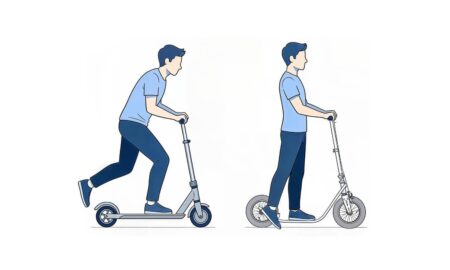
On human-powered scooters, many riders move asymmetrically by default. One leg pushes. The other stands. Over short rides, this rarely feels relevant. Over longer rides or repeated daily use, some riders may start to notice the pattern more clearly.
Hip flexor strain in everyday movement
The hip flexors are involved in almost every step we take. They lift the leg, stabilize posture, and help maintain balance. They do not need extreme loads to become irritated. Repetition alone can be enough.
In everyday contexts, strain often develops without a clear starting point. There is no single moment when something “goes wrong”. Instead, movement becomes slightly less fluid, then slightly more restricted. Many riders adapt without realizing it.
Asymmetrical pushing on scooters
Scooters rely on a simple movement pattern: push with one leg, stand on the other. The pushing leg works dynamically, while the standing leg stabilizes the body in a mostly fixed position.
Many riders are fully capable of switching legs, even on traditional kick scooters. This is especially common among younger or fitter riders, or those with better balance and quicker reactions. Leg switching itself is not a rare skill.
In practice, however, it is often harder to learn and maintain on conventional scooters, especially while moving. Narrow decks, higher standing positions, and limited stability make switching feel less natural, particularly once the scooter is already in motion.
Over time, many riders get used to pushing from one side. The movement becomes familiar. When they try to switch, especially starting from a standstill on the less familiar side, the situation can feel uncertain or unstable. Not because they cannot do it, but because it no longer feels safe.
From a design perspective, this distinction matters. The question is not whether leg switching is possible, but how easily and naturally it happens during real rides.
Why leg switching often fades in practice
Leg switching is often described as a technique issue. In reality, it is strongly influenced by design.
Even short moments of standing with both feet side by side can feel awkward. On narrower decks, riders often rely on small hopping or skipping movements to switch legs instead. These techniques can work, but they require timing, confidence, and good balance, especially while the scooter is moving. As a result, riders stay longer on their dominant side than they expect.
This is usually not a conscious choice. It is a response to how the scooter feels under the rider.
Design implications
From a design perspective, this is primarily a question of how different scooter layouts influence rider behavior.
A stable platform, predictable behavior, and enough space to stand naturally make it easier to rest, reset, and switch roles between legs. Over longer rides, this matters more than raw efficiency.
These notes suggest that body-friendly scooting is shaped as much by what a scooter allows the rider to do as by how it moves forward.